
Why post-raise health and longevity ventures stall at the moment they appear strongest, and what to do about it.
Most founders expect growth to feel stabilising.
- Revenue increases.
- The team expands.
- Investors lean in.
- Partnerships get larger.
On paper, everything looks stronger.
And yet, this is often the moment companies become most fragile.
Over the past decade building and scaling ventures across the UK, Europe and Africa, I’ve seen this pattern repeatedly. Companies don’t usually break when revenue slows, rather they break when it accelerates. Not because demand disappears, but because structure hasn’t evolved at the same pace as scale.
The Acceleration Trap
At £1M ARR, informality works.
- Decisions are fast.
- The founder carries context.
- Business development is relationship-driven.
- Governance is light.
At £3–5M ARR, the environment changes.
- Investor scrutiny increases.
- Board expectations tighten.
- Margins come under pressure.
- Partnerships become more complex.
- Regulatory exposure expands.
The company is being judged like a scale-up, yet it may still be operating like a start-up, which is where tension builds. More sales don’t fix that - they expose it.
Acceleration amplifies:
• Informal processes
• Founder bottlenecks
• Personality-led growth
• Governance gaps
• Decision fatigue
• Cultural drift
Under pressure, small compromises start to feel reasonable. Standards bend, clarity erodes, and focus shifts from discipline to momentum. This stage is predictable, and it is solvable.
But it requires intervention, not more sales.
What Investor-Ready Scale Actually Requires
When founders tell me they want to grow faster, I ask a different question:
What does investor-ready growth look like in your business?
It usually means:
- Revenue that is repeatable, not opportunistic.
- Business development that is systemised, not personality-led.
- Governance that protects valuation, not reacts to crisis.
- A founder who can operate strategically, not just tactically.
- A narrative that holds up under scrutiny.
Investor-ready scale is not just bigger numbers. It is structural maturity. And structural maturity rarely emerges organically.
It must be architected.
Founder Energy Is Infrastructure
There is another pattern I see at this stage.
The founder is still the operating system.
They hold:
Context.
Partnership relationships.
Hiring decisions.
Capital conversations.
Crisis resolution.
As scale accelerates, the demands on their time and decision making increase. And a depleted founder cannot build a durable company. This is not about wellness. It is about performance risk. When founder energy erodes:
Decision quality drops.
Risk tolerance distorts.
Standards slip.
Reputation becomes fragile.
Founder capacity is infrastructure. If it weakens, the business feels it.
Who I Work With
I don’t work with early-stage founders experimenting with product-market fit.
My work sits in a very specific transition.
I partner with post-raise health and longevity ventures, typically £1–10M ARR, navigating the shift from early traction to structured, investor-ready scale. These companies often have:
Proven product
Revenue momentum
Capital backing
Expanding teams
Growing regulatory exposure
But internally:
Systems are stretched.
Governance is still evolving.
Business development is personality-driven.
Founder decision load is unsustainable.
This is where structural intervention matters.
How I Help
Through Well Purposed, I architect the commercial and governance infrastructure that allows scale to stabilise rather than fragment.
This includes:
• Converting opportunistic revenue into repeatable growth engines
• Systemising business development and partnership strategy
• Strengthening governance maturity under board pressure
• Aligning ambition with operational readiness
• Preparing ventures for investor scrutiny and cross-market expansion
It is deliberate structural work at the point where growth becomes fragile.
Because speed without preparation is risk. And risk compounds faster than revenue.
Growth Deserves Preparation
Health and longevity ventures operate in complex environments.
Trust matters.
Regulation matters.
Capital expectations matter.
Reputation compounds slowly, and erodes quickly.
Rapid growth is not the problem.
Lack of preparation for growth is.
If you’re being judged like a scale-up, your structure needs to behave like one. That shift, from traction to structure, is where durable companies are built.
A Note on Influence
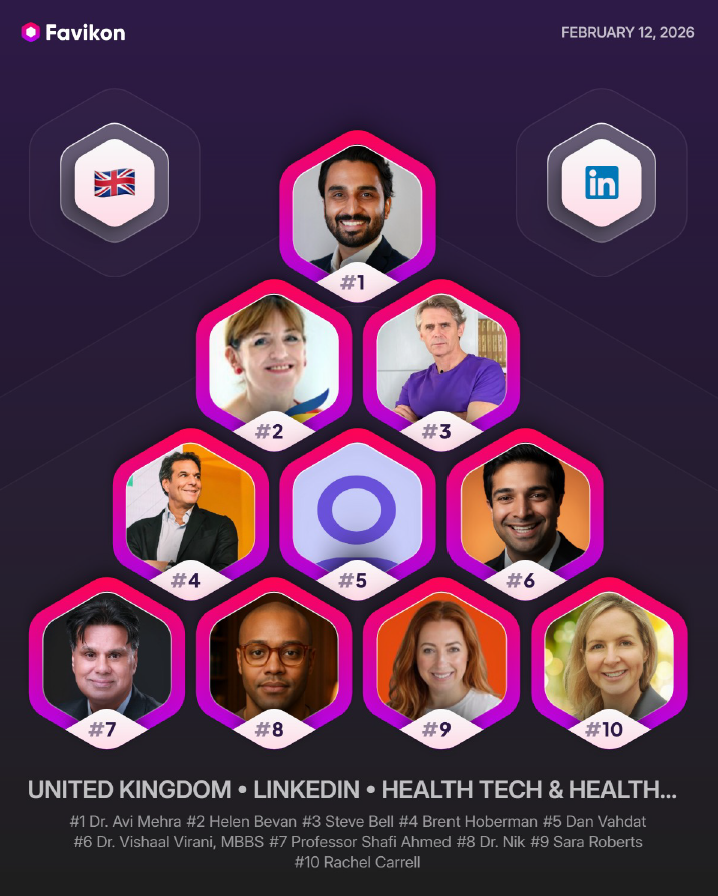
This week, Favikon released its global rankings after analysing over a million LinkedIn profiles across 100 countries and 100 niches.
I’ve been ranked in the Top 10 most influential voices in HealthTech.
That recognition is encouraging.
Over the past year, I made a conscious decision to stop posting reactively and instead build a body of work around one clear idea. Instead of chasing engagement, I focused on:
• Repeating a defined intellectual territory
• Speaking about scale under capital and regulatory pressure
• Sharing lived operator experience, including failure
• Connecting governance, trust and commercial performance
Influence, if it comes, is a by-product of clarity and consistency.
If you’re building in health or longevity, credibility compounds.
If this stage feels familiar in your venture, you’re not alone. And you’re not broken. You’re transitioning. From traction to structure.
That’s where the real work begins.
📄 Download the playbooks:
Sara





Responses